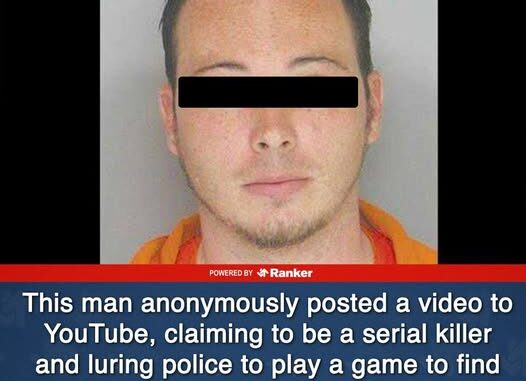
In 2009, Andrew Haley used the handle “catchmekiller” to post an anonymous video in which he claimed to have killed 16 women. After hinting two of his victims were missing persons, the authorities got involved, tracked Haley down, and apprehended him. Despite Haley’s claims, it turned out the video was a hoax. But instead of letting Haley go on his way, the Georgia State Police charged him with providing false statements and tampering with evidence.
Andrew Haley’s tale reads as a “what not to do” when creating a viral hoax or an online game – what Haley says he was doing. By pulling actual missing persons into his “game,” Haley wasted the authorities’ time and caused real pain for the people forced to relive the disappearance of a loved one.
- The “Catch Me Killer” Video Invited Investigators To Find Andrew HaleyIn February 2009, Andrew Haley anonymously posted a video to YouTube where he confessed to murdering 16 women and hiding their remains. With his face blurred and voice distorted, Haley called for the authorities to play along with him. He also promised to provide a clue every week until they located the victims, saying “once all 16 bodies are found, you’ll know exactly who I am.”In the video, Haley tells the police not to “chase” him, mimicking the tone of John Doe from David Fincher’s Se7en. If Haley really envisioned the whole thing as a game, he didn’t make it obvious.
- Haley Mentioned Real Missing Persons In His VideoThanks to our friends at @lynxbusorlando this bus will be traveling the region spreading the word about the ongoing Jennifer Kesse investigation. pic.twitter.com/cML7aPoBzA— Orlando Police (@OrlandoPolice) January 24, 2018In the YouTube video, Haley claims he killed 16 women. While he doesn’t mention any of them by name, he does reference two prominent missing persons. The first, Tara Grinstead, disappeared in Georgia under mysterious circumstances in 2005. While Haley doesn’t say her name, he discusses Grinstead’s history as a pageant contestant:”Who is she? What does she do? You answer me this, and I will give you her body. She was still wearing her favorite pair of jeans but not her beauty queen silk.”The second missing person Haley brings up is Jennifer Kesse of Orlando, Florida. Kesse disappeared in 2006, with no DNA evidence or phone records indicating what occurred. Haley even sent Kesse’s father a link to his video, along with the message “Maybe I can help.”
- The Police Tracked Haley Using His IP Address
- Photo:
- You Belong In Longmont
- flickr
- CC-BY-NC-ND 2.0
- Photo:
- Haley Received Two Years Of Work Release And 13 Years ProbationOnce authorities apprehended Haley, it became clear he didn’t possess any knowledge about the location of Jennifer Kesse or Tara Grinstead. Haley was arrested on charges of tampering with evidence and making false statements, with GBI spokesman John Bankhead explaining, “There was nothing to indicate he was involved in any of these murders.” During the trial, attorney Kristin Jordan said of the video, “It was creepy, it was hurtful, but it was not criminal.” Despite the defense, Hayley received two years in a work-release program and 13 years probation.
- Haley Believes Police Violated His First Amendment Rights
- Photo:
- Haley’s False Statements Created Real ConsequencesThe legal team for the defense argued Haley had been honest with authorities from the moment they located him. They claimed Hayley admitted to building an online game, meaning he never made false statements to the police. The authorities, however, say Haley’s reference of real-life tragedies in his video left them no choice but to investigate the claims as real – thus wasting investigative hours and taxpayer money. Assistant District Attorney Lee Darragh agrees with the authorities, telling the Washington Post the video constituted a “false statement in a missing person investigation that was being conducted by the Georgia Bureau of Investigation at the time the statement was made.”
- One Charge Was Overturned
After appealing both of his convictions in 2011, the Georgia Supreme court sided with Haley on one aspect of his case. They agree Haley never technically tampered with evidence, but his false statement charge remained because he never explicitly let anyone know the video was fiction. Though Haley’s attorneys claimed their client’s First Amendment rights had been violated, the court felt the defendant never exercised his ability to tell viewers the whole thing wasn’t real. Justice David Nahmias wrote, “Haley knew and intended that his false statement as the ‘catchmekiller’ would come to the attention of a state or local government agency in Georgia that had the power to act on it.”
- Haley’s Mother-In-Law Thinks The Police Should Have Been More LenientAfter Haley’s arrest in 2009, his mother-in-law (who wishes to remain anonymous) spoke to CBS News about his arrest. While she admits Haley should have explained his claims were fictitious, she didn’t think he did anything wrong. His mother-in-law then called the investigation “absolutely childish” and “a waste of taxpayer money.”She went on to say the GBI’s claim they wasted hundreds of hours and tens of thousands of dollars was their own fault, stating:”Kids make mistakes every day. People get on YouTube and cell phones and do things. That doesn’t mean they set out to harm anybody.”
- Drew Kesse Didn’t Think Haley Actually Killed His Daughter#VIDEO: https://t.co/TtO1I0yMsA It’s been 12 years since #JenniferKesse went missing. Jennifer Kesse’s family to Orlando police: Hand over her case. #Orlando #MissingPerson pic.twitter.com/Mgv28R89bo— Red Huber (@RedHuber) January 24, 2018When Andrew Haley anonymously reached out to Drew Kesse in 2009 with a link to his video and a message reading “Maybe I can help?,” it left Kesse devastated. He didn’t think Haley killed his daughter, though. Kesse admits the video brought him back to the first moments he realized his daughter was gone, but he remained skeptical of Haley’s involvement.When asked if Haley deserves prosecution for the prank, however, Kesse told CBS News, “Absolutely, hands down, not even a question of a doubt, he should be prosecuted. You can’t screw with people’s lives.”
- The Hoax Was Meant To Be A GameThe rise of creepy online games which begin on YouTube before spilling out into the real world has been hard to ignore. The best versions involve large numbers of people trying to solve a puzzle. Hunt A Killer, for example, took the idea of disparate people solving a fictional murder and profited from it.During Haley’s defense in 2010, he and his legal team claimed that by posting the YouTube video, Hayley was trying to get people interested in his game. Because no real serial killer existed, they argued, Haley didn’t technically make a false statement.

