arenting an adolescent can be one of the most challenging experiences for any parent. Adolescence is a time of rebellion, defiance, and change, and when those behaviors show up in the home, it can feel like the ground is constantly shifting under a parent’s feet. What’s more, when a child begins to display disrespectful behavior, it can make even the most seasoned parents question what they might be doing wrong or if they are doing enough to raise their children with the right values.
One mother, Heidi Johnson, experienced this firsthand when her son Aaron, a 13-year-old teenager, started acting out in ways that were difficult to handle. Over time, Aaron’s behavior had become increasingly disrespectful, and Heidi, like many parents, found herself feeling unheard and unappreciated. She knew she had to take action but wasn’t sure how to address it in a way that would make an impact.
That’s when Heidi decided to write a letter to Aaron, not just to express her frustration, but to help him understand the value of respect, responsibility, and gratitude.
The Letter That Changed Everything
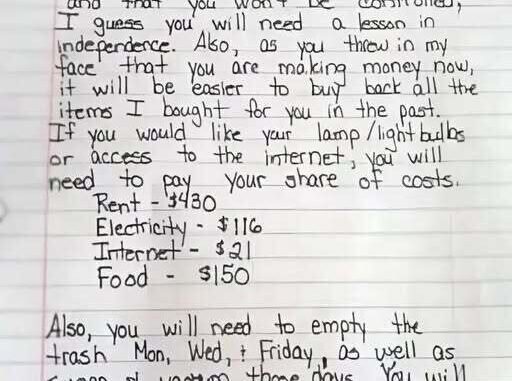
Heidi’s letter to Aaron was a direct, no-nonsense approach to teaching her son about the realities of life. Instead of simply lecturing him, she used a creative and impactful method to drive her message home. The letter, handwritten and carefully crafted, began with Heidi addressing Aaron as her son, but she also pointed out that his recent actions had made her feel as though she was nothing more than a “roommate” in their shared home.
“I have done my best to raise you,” she wrote. “But it has become clear that you have taken me for granted, and I need to remind you what it means to live in this house.”
Heidi’s message wasn’t meant to be cruel or harsh; it was a wake-up call, a chance for Aaron to see life from a different perspective. As the letter went on, Heidi did something unexpected—she included a detailed bill for rent, food, and other household expenses, adding up to more than $700. She explained that if Aaron wanted to continue living in the house, he would need to pay his share of the costs, just as an adult would in the real world.
Food
The Viral Letter That No One Expected
After Heidi posted the letter on her Facebook page, she didn’t anticipate the kind of attention it would garner. Initially, she shared it as a way to vent to her friends, perhaps hoping for some empathy from others who had dealt with similar issues. But the response she received was overwhelming. Within hours, the letter had gone viral, and people from all over the world began sharing their thoughts, offering support, and discussing their own experiences with their children’s behavior.
Heidi was stunned by the reaction. “I never expected it to go viral,” she said. “I just needed to communicate with Aaron, and in doing so, I think I tapped into something that resonated with a lot of people.”
In the comments section, many parents expressed how they appreciated the tough love approach. Others shared their stories of raising teenagers and how they often struggled with similar issues of disrespect. Heidi had inadvertently started a conversation that was much larger than she had imagined.
Despite the overwhelming response, Heidi made it clear that her goal wasn’t to shame Aaron or embarrass him. In a follow-up post, she assured her critics that she never expected her son to actually pay the bill. “This is about teaching him a lesson in responsibility,” she wrote. “I want him to understand the value of what he has, and to appreciate the effort that goes into making our home comfortable.”
Fostering Gratitude and Responsibility
Heidi’s method was unconventional, but the message behind it was clear: life isn’t always about taking things for granted. The bill was meant to be a metaphor, a way to help Aaron see how much he had, how much it cost to maintain their home, and how much his mother worked to provide for him. Through this approach, Heidi hoped that Aaron would develop a sense of pride in his home and an understanding of what it truly meant to live there.
“I will not abandon my 13-year-old if he is unable to pay rent,” Heidi clarified. “This is not about money. It’s about teaching him the importance of gratitude, hard work, and the value of what we often take for granted.”
At the core of Heidi’s letter was an intention to create an environment of mutual respect. She wanted her son to realize that being a part of a family meant more than just coexisting under the same roof. It required contributing in meaningful ways, both emotionally and practically.
The Moment of Change
After the viral post, Heidi noticed something different in Aaron. It wasn’t an immediate transformation, but small changes began to appear. At first, it was the little things—Aaron began cleaning up after himself without being asked, offering to help with groceries, and even putting his phone away during family meals. These seemingly insignificant actions were evidence that the message had begun to sink in.
But the real turning point came one evening when Heidi came home from work to find Aaron attempting to cook dinner for her. It was an attempt at something he had never done before, and it was a bit of a disaster. Flour was everywhere, the sauce was burning, and the noodles were overcooked. But despite the mess, there was a sense of sincerity and effort behind his actions.
“I was gonna cook for you,” Aaron said sheepishly, “like… to say thanks. For, you know, everything.”
Heidi couldn’t help but smile at the gesture. She stepped in to help salvage the meal, and together they laughed over the culinary disaster. It wasn’t the meal that mattered—it was the thought and the effort that Aaron had put into making it. It was a small but powerful indication that something had clicked for him.
Later that evening, as Heidi folded laundry in her room, Aaron knocked on her door. When she opened it, he handed her a small, crumpled envelope. Inside was $14 in crumpled bills and change. Aaron had written a note on a piece of notebook paper:
“First payment toward rent. I’ll pay more when my next video gets views. Love, your son (and not your roommate).”
The note was simple, yet meaningful. It wasn’t the amount of money that mattered; it was the thought behind it. Aaron had made the choice to show gratitude, to take responsibility, and to humble himself in a way that was not easy for a 13-year-old.
Heidi was deeply moved. She placed the envelope in her keepsake box, right next to Aaron’s first drawing from kindergarten. As she reflected on the gesture, she realized that the moment had nothing to do with rent or money—it was about growth. It was about her son learning to acknowledge the hard work that went into making their family life possible.
The Power of Parenting Through Tough Love
In the weeks that followed, Heidi noticed more changes in Aaron. His attitude had softened, and he seemed to approach his responsibilities with a greater sense of awareness. He began helping around the house more, taking the initiative to do things without waiting for his mother to ask. The once-defiant teenager was slowly but surely evolving into a young person who understood the value of respect, responsibility, and family.
For Heidi, the experience was a reminder of how powerful parenting can be when done with intention and love. It wasn’t about punishing Aaron; it was about helping him understand the consequences of his actions, fostering a sense of gratitude, and teaching him the lessons that would prepare him for adulthood.
Parenting isn’t about being understood immediately or having your child always agree with you. It’s about planting seeds of wisdom and allowing them to grow, even if it takes time. Sometimes, those seeds take years to bloom, but when they do, they’re worth the wait.
Heidi’s Message to Other Parents
As Heidi’s story went viral, many parents reached out to her for advice. They shared their own struggles with raising teenagers and asked how they could approach similar situations. Heidi became an unlikely parenting advisor, offering her thoughts on how to approach difficult conversations with children, the importance of setting boundaries, and the need for consistent love and support.
“I’m not saying this approach works for everyone,” she said in a follow-up post. “But I think it’s important to remember that tough love doesn’t mean you don’t love your child. It means you care enough to help them understand the world and their place in it.”
Conclusion: The Long-Term Impact of Heidi’s Letter
Heidi’s letter to Aaron might have started as a moment of frustration, but it became a pivotal point in their relationship. It was a lesson for both mother and son in the power of communication, the importance of gratitude, and the value of taking responsibility. The viral nature of the post showed just how many parents could relate to the struggles of raising a defiant teenager, and it sparked important conversations about parenting, respect, and family dynamics.
Ultimately, the letter wasn’t just a tool to teach Aaron a lesson—it became a powerful reminder for all of us about the lasting impact of our actions and the power of love in shaping the next generation.