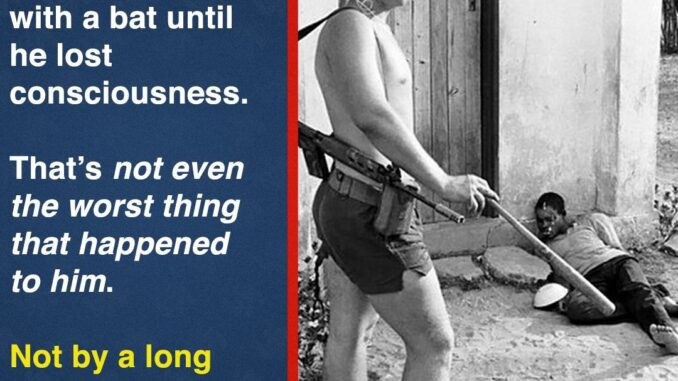
Photographer J. Ross Baughman was on assignment in Rhodesia in 1977. Rhodesia, a former independent state now known as Zimbabwe, experienced ongoing conflicts between Blacks and whites after the former British colony asserted its autonomy. Violence between African nationalists and the white-controlled parliamentary government escalated in 1977 – the timeframe within which Ross took several photos of prisoners held by Rhodesian Security Forces.
As a freelancer working for the Associated Press, Baughman infiltrated a white cavalry group within the Rhodesian Security Forces. This gave him access to the inner workings, activities, and tactics used by the troops. It was also a controversial move, one that would almost cost him a Pulitzer Prize.
J. Ross Baughman’s Methods Were Unconventional
J. Ross Baughman didn’t force his way into the Rhodesian Security Forces or use covert methods to join. He traveled with a cavalry unit tasked with combatting anti-government guerrilla fighters, something he was able to do after he proved he could ride a horse and carry a weapon like any soldier. He also wore a military uniform, but didn’t tell the Associated Press about it.
The group Baughman accompanied, called Grey’s Scouts, was led by Major Mike Williams, an American in the Rhodesian Army and someone Baughman met at a party. In 2014, Baughman explained why he took that approach to get his story:
While the foreign press corps in Rhodesia resigned itself to rumors and second-hand reporting, I introduced myself to fire-breathing, anti-communist mercenaries who had all just left America’s lost war in Vietnam. They gathered every Saturday for private barbecues, and knew I worked for the Associated Press. But because I asked to see their angle on this new guerrilla war, first hand and up-close, they were willing to take me along with the last fighting cavalry in the world.
When asked about wearing a uniform and carrying a gun, Baughman explained that the former was common for journalists. The latter was also done in combat and, for Baughman, was “the price of admission.” He said:
The Rhodesians insisted that I wear subdued, camouflage clothing so I would not stick out and give away my movements with the troops. The Rhodesians were also trained to shoot on sight any of the mismatched Cuban and Warsaw Pact uniforms that the guerrillas pieced together. The gun was required for the Rhodesians’ peace of mind, just in case I became cut off from the unit. Moreover, I willingly wore the uniform so I could reduce the troops’ self-consciousness. I wanted them to behave as naturally as possible.
One Of Baughman’s Pictures Showed A Black Captive Held By A Noose
The photos J. Ross Baughman received a Pulitzer Prize for in 1978 were taken during a three-day outing with the Grey’s Scouts. The Washington Post reported on December 3, 1977:
Baughman said he saw white soldiers commit atrocities… he saw the soldiers beat, kick and threaten blacks; fasten rope nooses around the necks of two prisoners and force them to run or be dragged several miles behind horses, and repeatedly bunched a black soldier before pinning him to the ground, wrapping his shirt about his head and pouring water from a bucket over his nose and mouth until he passed out.
Another Image Included A Guerrilla Who Had Been Beaten And Tortured For Information
The man on the ground was not dead, but was unconscious when J. Ross Baughman took this photo. He’d been beaten by 19-year-old Graham Baillie to extract information about the location of guerrillas in the region. In a report issued by the Rhodesian government in 1976, it stated that guerrillas committed widespread atrocities against Blacks and whites alike. The military also asserted guerrillas had killed more than 1,250 civilians during the previous five years.
Baillie had used a bat and only stopped when the young man, Moffat Ncube, lost consciousness. Prior to that, he’d been stripped, forced to watch his wife and daughter get beaten, and had water forced down his throat.
Baughman quoted a lieutenant as saying, “God, I hate doing this. This war makes me sick.” Ncube reportedly died soon after as a result of his injuries.
When the photo and the report by Baughman accompanying it were published, the Rhodesian government said, “75 percent of the details either were exaggerated or wrong.” Officials claimed Ncube was alive and would serve as a witness in any court martial proceedings that took place.

Baughman’s Third Picture Showed A Rhodesian Soldier Interrogating Prisoners
According to the New York Times, J. Ross Baughman “said the prisoners had to hold this position under the noon sun while the soldier clicked a pistol in their faces.” The prisoners did this for about 45 minutes, and while Baughman captured much of it on film, most of that documentation was taken from him when he left Africa.
The interrogator reportedly wanted to know where guerrillas were hiding. When one of the prisoners faltered, he was beaten and knocked unconscious, only to be awakened by a gun firing into the air.
Major Mike Williams later claimed Baughman had asked his men to stage the pictures he took, asserting the images were “made up of inaccuracies and nonsense.”

Baughman’s Photos Became Controversial For More Than Just Their Content
J. Ross Baughman’s images of the Rhodesian conflict were one of three submissions in contention for winning the Pulitzer Prize for Feature Photography in 1978. Baughman’s work was at the top of the list the Advisory Board received before handing out the award, alongside Taking Jesus to Jail by John H. White from the Chicago Daily News and photos of the Culmer ghetto in Miami by Michael O’Brien.
The jurors who assessed Baughman’s photos had concerns about how he’d gotten them. The same was true for many of Baughman’s colleagues. By wearing a uniform and carrying a gun, Baughman misrepresented himself and violated “the standards of most news organizations.” Additionally, Keith Fuller from the Associated Press did have “doubts” about Baughman’s tactics because,
Baughman said he pretended he was totally sympathetic with the Rhodesian Army’s point of view and in one instance he participated in some slight way in something that was going on.
